Canine Lymphoma: What to Do When the World Stops
The Moment Everything Changes You were just petting them. Maybe you were scratching under their chin or rubbing their neck, and you felt it. A lump. It was firm, maybe the size of a marble, and it did not seem to hurt them, but it definitely was not there last week. Then came the vet visit, the needle test, and that heavy word: Lymphoma.
If you feel like you are underwater right now, that is normal. Your pet is your family, and hearing a cancer diagnosis feels like a door slamming shut. But while the diagnosis is serious, it is not the end of the story. It is just the start of a different chapter, one where we focus on comfort, science, and the bond you share.
What is Actually Happening? In plain terms, lymphoma is a cancer that affects the immune system. Specifically, it involves cells called lymphocytes. Since these cells live in the lymph nodes and travel through the blood, the cancer is “systemic.” This sounds scary, but it actually gives us a clear target. Because it is everywhere, we treat it by supporting the whole body.
Step 1: Just Breathe The most important thing to do in the first 24 hours is nothing. Unless your pet is having trouble breathing or cannot eat, you do not have to make a life-changing decision this second. Take a day to just be with them. Go for a slow walk. Let them sniff the grass. Your pet does not know they are sick; they only know they are with you.
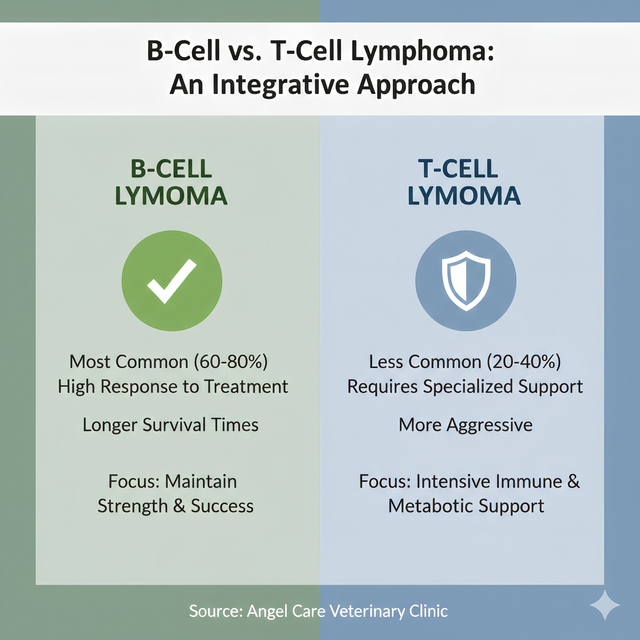
Step 2: Get the Specifics Not all lymphoma is created equal. There are two main types: B-cell and T-cell. Think of them as different “brands” of the same problem. B-cell usually responds very well to support, while T-cell can be a bit more stubborn. Ask your vet which one it is. If they are not sure, ask for a “Parr test” or a biopsy. Having the right name for the problem makes the solution much clearer.
Step 3: Look at the Whole Dog Before we talk about medicine, look at your pet. Are they happy? Are they eating? This is what we call “Quality of Life.” I suggest keeping a simple calendar on the fridge. Put a “smiley face” for a good day and a “sad face” for a bad day. If most days are still smiles, you have time to weigh your options carefully.
Step 4: The Integrative Toolbox We do not have to choose between “natural” and “medical.” We can use both.
-
Food as Medicine: Cancer cells love sugar and simple carbs. Switching to a diet higher in clean protein and healthy fats can help “starve” the cells while keeping your pet strong.
-
The Power of Calm: Stress produces cortisol, which is not helpful right now. Keeping the house quiet and the routine steady is a medical necessity, not just a nice idea.
-
Supplements that Help: Things like Omega-3 fatty acids or specific mushrooms can support the immune system. But please, check with us before adding things, as some “natural” cures can actually get in the way of other treatments.
Step 5: Prep Your Supplies You are going to be a bit of a nurse for a while. Get a small folder. Put all your vet records in it. Buy a thermometer and some low-sodium bone broth. If your furbaby gets picky with food, a little warm broth can be a game-changer.
Step 6: Set Your Boundaries You will hear a lot of advice from the internet and well-meaning friends. It is okay to say, “I am working with a professional team I trust, and we have a plan.” You do not have to try every “miracle cure” you see on Facebook.
Step 7: Focus on the “Win” In integrative care, a “win” is a day where your pet feels like themselves. If they are wagging their tail, if they are barking at the mailman, or if they are snoring on the couch, that is a successful day. We are not just fighting a disease; we are protecting a life.
When to Reach Out If you notice they are suddenly very lethargic, if their gums look pale, or if the swelling in their neck makes it hard for them to swallow, do not wait. Those are the moments when extra help is needed immediately.
A Final Thought You are doing a great job. The fact that you are even reading this means you are an incredible advocate for your pet. Take it one meal at a time, one walk at a time, and one day at a time.